"Any significantly advanced technology is indistinguishable from magic." - from Arthur C. Clarke's Three Laws of prediction.

Tuesday, October 16, 2012

"Where No Man Has Gone Before" Alternate Footage


Sorry for the lack of posts lately. I've recently gotten a job and no longer have all the free time I once did to write things like this. I won't be posting as much as I did when I first started, but I'll continue to put articles up every few weeks or whenever I can. So make sure to check back for updates :)

Here's the original introduction used for Star Trek's second pilot, Where No Man Has Gone Before. This intro (as well as some other elements) were later edited/removed when the series was green-lit for production and had to meet the then-standard 50-minute time limit. The removed footage was long-thought to be lost, but was recently rediscovered by a German film collector and made available on the Season 3 Blu-ray release of TOS. The existence of this 'alternate version' of the second pilot has been known to fans since before series actually premiered (and low-res VHS dubs have been floating around ever since), as it was shown at a conference only days before the first broadcast episode, The Man Trap, hit the airwaves.

Anyway, enjoy this little piece of early Star Trek production history!

Wednesday, September 19, 2012

The "Battlestar Galactica" that Never Was: The Desanto-Singer Project

desanto-singer bridge


 I've always enjoyed classic Battlestar Galactica, despite its flaws. Although the reimagined series portrayed events in a far more realistic light, the old series was simply a lot of fun. It's unfortunate, though, that the series' expensive price tag and sometimes too-family-friendly plots (a result of meddling by ABC network execs) eventually led to the show's downfall after only one season. Even so, Galactica still makes for some enjoyable '70's sci-fi, filled with space battles, obvious villains, action-driven plots, and an excellent soundtrack, to say the least. Definitely recommended!

Originally announced in the early 2000's, the studio and Glenn A. Larson-endorsed Desanto-Singer Project was one of only three Battlestar Galactica revival attempts (the other two being Glenn A. Larson's Battlestar Atlantis and Richard Hatch's Battlestar Galactica: The Second Coming) proposed since the series' cancellation in late 1979. Although the series did have a short-lived spin-off, Galactica 1980, the show was generally panned by fans and critics alike (except the final episode) due to it's questionable writing, which, amongst other things, was filled with a boatload of science fiction cliches. Some have even gone as far as to forget it ever happened, leaving the door open to future stories involving Galactica discovering Earth.

Of the three revival attempts, the Desanto-Singer Project, headed by producer Tom Desanto and director Bryan Singer respectively, was the only one to come even close to production, only hampered by what would later become the 'reimagined' or rebooted Battlestar Galactica, which premiered in 2003 to technical and popular acclaim. In fact, the show was only eight weeks away from filming when the news came.

The basic storyline of the Desanto-Singer Galactica pilot was as follows:

"The continuation, built from the events of the episode "The Hand of God", tracks the Fleet after Galactica and Pegasus shake off the Cylon pursuit. The opening depicts a Colonial classroom where a teacher reviews the history of the Fleet, 23 years prior. Pegasus is confirmed as lost, and the Cylons themselves paid a high price in the battle. 

The quest for Earth continues, but Commander Adama has died, and Colonel Tigh assumes command. The citizens of the Fleet tire of spacefaring life, and, after a civil uprising, convince their leaders to settle the Fleet in an asteroid field that is rich in resources. The new colony, named New Caprica, builds new ships, settlements and facilities from the asteroids.  


The Cylons themselves reflected on their failures and determined that free will was a serious issue that caused problems in their logic-based civilization. When Baltar is found marooned, the Cylons initially held him up as a perfect example of their failures. Baltar convinced the Cylons that some qualities of humanity are useful, and underwent a cybernetic transformation into a new Cylon model to prove this. More dissent arose among the Cylons as a result, leading into a civil war. Out of the ashes of their war came a new Cylon race that, instead of obliterating the remnants of humanity that it finds, begins instead to assimilate the conquered humans as Cylon cyborgs.    

The character known as Boxey has grown up and assumed command of Galactica under the name of Commander Orin who faces the loss of his command from political pressure to decommission the battlestar as it has become outmoded and difficult to maintain. The political pressure becomes a command. The Colonial president, a woman named Mara, visits the battlestar in her shuttlecraft to attend the battlestar's decommissioning ceremonies.
 
Just as the battlestar's systems are powered down, the Cylons, who have studied New Caprica in secret and devised an elaborate plan for success, strike." 


 The project was green-lighted in June, 2001, with Fox on-board to host the two-hour pilot. Construction of viper mockups and sets began shortly thereafter in less-expensive Vancouver, Canda. Scripts were drafted and revised, ships were redesigned and modeled in CGI, and the cast was assembled. Both Dirk Benedict (Starbuck) and Herb Jefferson (Boomer) were signed on to reprise their original roles, despite the producer's original intent to not include any of the original actors.

Then, after the 9/11 attacks on the World Trade Center in New York, major flight delays and heightened security forced Singer to leave the production in order to meet deadlines for his new X Men film. Production on Galactica was halted for roughly a month after the attacks as the network searched for a new director to take Singer's place. The execs were also understandably nervous about using the concept of a Cylon sneak attack only a month after 9/11, a fact which probably contributed to the project's cancellation. With Singer's departure, support for the project quickly fell apart, eventually leading Fox to pull out in favor of pursuing Josh Weadon's space-western series Firefly instead (another very good, but short-lived series, by the way).

Unbeknownst to Desanto, who was still optimistic that the production would move forward with a new director, the Sci-Fi Channel began work on a totally new version of Galactica, which eventually evolved into the 2003 reboot. The producers of the reimagining (amongst them, veteran Star Trek writer Ronald D. More) intentionally distanced themselves from the concepts developed by Desanto and Singer, taking a completely different approach to the series while still retaining the basic premise of the '70's version. With the project effectively dead, the nearly-completed sets and mockups were placed in long-term storage. However, when the studio's storage lease ran out, these items were broken up with sledgehammers and disposed of, effectively ending any hopes of a continuation of classic BSG.

Despite all this, the Desanto-Singer Project met it's end in the face of a new beginning for the
Battlestar Galactica franchise. Although not all are happy with the new direction and darker done of the reimagined series (I'm a bit on the fence myself...), it's here to stay, and ended up being one of Syfy's most successful shows. There's been talk of bringing back the old show for years, so I wouldn't be at all surprised if another attempt is made in the future. And if someone were to combine the best elements of both the classic and reimagined series...well, then they'd really have something. Hmmmm....

For further production details and a full plot synopsis, check out
The Tombs of Kobol as well as the Battlestar Galactica Wiki. For more production concept art, including redesigned interiors, ships, and Cylon centurions, check out this link and this link


Saturday, September 8, 2012

Happy Anniversary Star Trek!

In honor of the 46th anniversary of The Original Series, here's a short piece of real person fiction for your reading pleasure, entitled Visit to a Weird Planet Revisited, by Ruth Berman.

Trek actors William Shatner, Leonard Nimoy, and DeForest Kelley switch places with their 'real' future counterparts, finding themselves transported off-set and onto the 'real' Enerprise, far in the future. The plot actually reminds be a bit of the movie Galaxy Quest...

I originally read this story in the anthology Star Trek: The New Voyages (released in 1976), which I picked up at a book sale back in 2005. Apparently, this tale has a sister story, which was actually written first and by different authors, entitled (coincidentally) "Visit to a Weird Planet". That story tells us what happens to Kirk, Spock, and McCoy when they try to 'play actor' on the plywood Star Trek sets, 300 years in the past. I haven't been able to find that story online anywhere (I think it only appeared in magazine form, and was never officially published), but if anyone has, let me know. I'd really like to read it.

"Visit to a Weird Planet Revisited" has been out for quite a while, so chances are you've read it, but I thought it appropriate for the occasion. Anyway, enjoy, and make sure to check out today's Trek-themed Google Doodle. It's pretty well done :)

Monday, September 3, 2012

Android Market on the Pandigital Nova - A Failed Experiment

I've had the Pandigital Nova for over a year now, and even though it's a low-end tablet, it works fairly well as an ereader, email, and web-surfing platform. It may not be as robust or have the support base of many other high-end tablets, but it's also quite a bit cheaper. For those of you who happen to have the Nova, you probably already know one of its biggest limitations: no access to the Android Market (aka Google Play). Even though that's never been a big problem for me, I thought it would be a nice feature to have, since third-party apps don't always do it. Well, that feature ended up being more trouble then it's worth.

I found a set of online directions here for rooting the Nova as well as installing, fixing, and updating Market. The first step was to boot the Nova into recovery mode and install an update package which would root the device. That went off without a hitch, and I successfully rebooted. Next, I got back into the recovery mode and installed another package, this time the installer for Market and several other included applications. That install also was successful. When I rebooted a third time, I found the Market icon and tried searching for several popular apps, including Dropbox, Gmail, and Youtube, but to no avail. Following the article's directions on what to do if apps were missing from the Market, I still couldn't resolve the problem. 

I ended up installing and reinstalling new and old firmware several times as well as doing a hard reset multiple times, loosing all my installed apps and settings in the process. I even went back and started the procedure from scratch, this time including a few optional steps the author of the tutorial had used to fix a few problems he had encountered. That ended up making Market work a little better, but it still wasn't where it should be. I probably should have cut my losses then, but being the perfectionist I am, I was still determined to make this work.

Tired and frustrated (by this time, it was almost 8:00 at night), I tried installing the new Google Play app on top of everything else I did, which ended up almost being a fatal mistake. After a reboot, my Nova would freeze at the Pandigital splash screen, and attempting a hard reset had no affect. I also tried manually installing the old firmware, but it wouldn't let me. I was pretty nervous at this point that I had succeed in turning my tablet into a useless paperweight, but I had one more thing to try. I downloaded an even older version of the firmware from Pandigital's website and successfully installed it from my SD card. Thankfully, my tablet booted, and I was able to upgrade to the latest firmware from there. After taking a little time to put everything back the way I like it, I'm now back up and running, sans the Android Market and the other official Google apps that came with it. I would have liked to save them if I could, but I'm just happy to be up and running. Folks, this is a perfect example of how not to install Market on your unsanctioned Android device. Even though risk is a big part of R&D, I think I'll leave my tablet well enough alone for now. That was a bit too close for comfort.

The more I think about it, the root of my problems (no pun intended) probably lies in the fact that the Android Market was recently merged with several other Google services to form Google Play. Throw in the fact that the Nova isn't a sanctioned Android device and that the tutorial I was referencing is over a year old, and you've got a recipe for disaster. It wasn't a total loss, though, since I did learn quite a bit about Android system recovery, firmware updates, and what it means to root a device. I also took the opportunity to customize my home screen a bit.

With that said, I may try my luck with the Amazon Apps Store, which seems much less concerned with whether a device is 'officially sanctioned' or not, and it doesn't require any rooting or a tutorial to install (I foresee a follow-up article in the near future...). Pandigital Nova users: please do let me know if you've had better success with installing Market/Google Play then I did. I probably won't go there again, but I am curious, since no doubt someone will find a way eventually. As our good friend Spock says, "There are always possibilities...".

As always, thanks for reading, and for those of you here in the States, Happy Labor Day!

Thursday, August 30, 2012

Comments issue resolved...

Sorry, folks, I had my settings as such that only registered Blogger users could comment on my posts (I wondered why things were so quiet...). It should now be open to anyone with a Google account.

In addition, articles can now be shared on Facebook, Gmail, Google + and Twitter!

Keep bearing with me as I adjust, tweak, and learn the ropes!

Wednesday, August 29, 2012

Transposing Music to E Flat: A Beginner's Guide


I've been playing the Alto Saxophone since the fourth grade, but I never really took it too seriously until the past year or so. I was an OK player throughout elementary, middle and high school, but I never reached the level many of my friends did. With my high school career quickly winding down, I realized something had to change if I wanted to improve my skills and continue playing outside the school system. Shortly before my senior year, I joined a musical ensemble at my church that plays very contemporary-style music for our Saturday evening Mass. I've had the opportunity to learn quite a few things from people who know quite a bit more then I do, both on the vocal and instrumental side of things, some of which I'm about to share with you.

Walking in the first day, I knew nothing about transposing music, nor did I know that I even needed to. I just assumed I'd be able to play any song I wanted straight out of the book. Well, I was partially correct. With the alto saxophone being an E (E Flat) instrument (not exactly a common key in the music world), I can indeed play any piece of music I want without transposing it...as long as I'm playing with another saxophone or flying solo. If the music is written for any instrument other then sax, and if I play with a group of non-E instruments, then the music must be transposed or else the notes I play will be wrong. To clarify, the notes I will be playing will be correct for an alto saxophone, but at the same time, the notes will not be the same ones being played by everyone else. In the music world, all notes on a page pretty much look the same, but it's the key a song is written in and the instrument used to play it that really counts. It really becomes a game of matching the pitch I play with the pitch someone else plays.

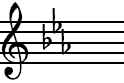
Key of E
What exactly does it mean to transpose music? Well, not all music is written in the same key. To put it another way, not all musical instruments can play exactly the same pitches or have the same ranges. For instance, a low G for me won't be the same for someone playing, say, trumpet, even though a G on any piece of music still looks like a G. That's because trumpet is a B instrument (a fairly common key) and sax is in E. Hence, some form of conversion is needed to make sure everyone is playing exactly the same pitches no matter their instrument.

If you've ever played scales in concert band, then you've transposed, by virtue of taking the notes up or down the staff to match the tones everyone else is playing. Now take that concept and apply it on a larger scale. In order for me to play any piece of music that's not specifically written for alto sax, I must take the written notes up the staff five steps or down three steps, taking into account any sharps or flats along the way. For example, a written middle B would become a high G or a low G in E. I typically transpose up the scale, but in some cases, going down is the better option (for instance, in times when going five steps up would make the transposed notes too high to play). Finally, throughout this process, the song's written key signature will remain the same as before. These simple rules are the literal key to converting a song from a non-sax-friendly part to a sax-friendly part. Also bear in mind that these same steps can be used to transpose music for any instrument, assuming you know how many steps up or down the scale to take. It really is as simple as that.
An example of transposed music. The top line is in the key of D, while the bottom has been transposed to B (two steps down, or a major third). The rhythm remains exactly the same; the notes played will simply be a bit lower.
Although this process is fairly simple, it does take practice. If you're good, and I mean really good, you'll develop the ability to sight transpose; in other words, you'll be able to read music in one key while playing it in another. I'll tell you right now, I'm not one of those people, so please don't ask. I would definitely recommend transposing some music and testing it out before jumping into any live performances. Trust me; I made plenty of mistakes early on, and I still do occasionally. I'm by no means an expert in Music Theory, nor do I pretend to be one. There are still plenty of things I've yet to master or understand, but take it from me, if you understand the basics of transposing, you'll be well on your way to becoming a skilled musician who can play any song put in front of you.

One more bit of advice: when I write out music, I use a piece of music composition software called MuseScore, which allows me to not only check to make sure all my sharps and flats are correct, but it also creates a professional-looking score that can be saved as a PDF. Despite it's idiosyncrasies, it's a great way to go if you'd rather not have hand-written notes scribbled all over your music. Highly recommended!

This has been my first music tutorial, and I hope you've found it helpful. Since this is my first official post, please do comment, and musicians: do let me know if I made any mistakes in the text above. Hopefully I didn't, but the last thing I want is to give bad information. In fact, the very reason I wrote this was because when I first started, I had trouble finding any information on this subject.

Thanks for reading, and keep checking back here in the future for other hints and tips! Next up, I'm switching gears to an article on the Star Trek: The Next Generation remastering project. You won't want to miss it!

Tuesday, August 28, 2012

Welcome!

Hello and welcome to my new blog, The Enterprise Bridge! This blog will discuss such topics as choral and instrumental music, photography, sci-fi, technology, and maybe even a few other things (we'll see...). I've more-or-less finished finalizing the layout of this page, although I'll continue to tweak it as the week goes on. I also hope to post my first music-related article shortly, so feel free to check it out and let me know what you think. I'm also more then open to friendly suggestions from bloggers who know the ins and outs quite a bit better then me, so don't be afraid to chime in.

Like I mentioned before, this is my first website, so bear with me as I learn the ropes. I hope to put something up at least once a week, but we'll see how things go.